Hear what clients and families notice between visits, while there is still time to respond.
Clients and families experience the gaps between visits. Field staff see the conditions around them. PulseMD brings both into an earlier operational picture for care coordinators.
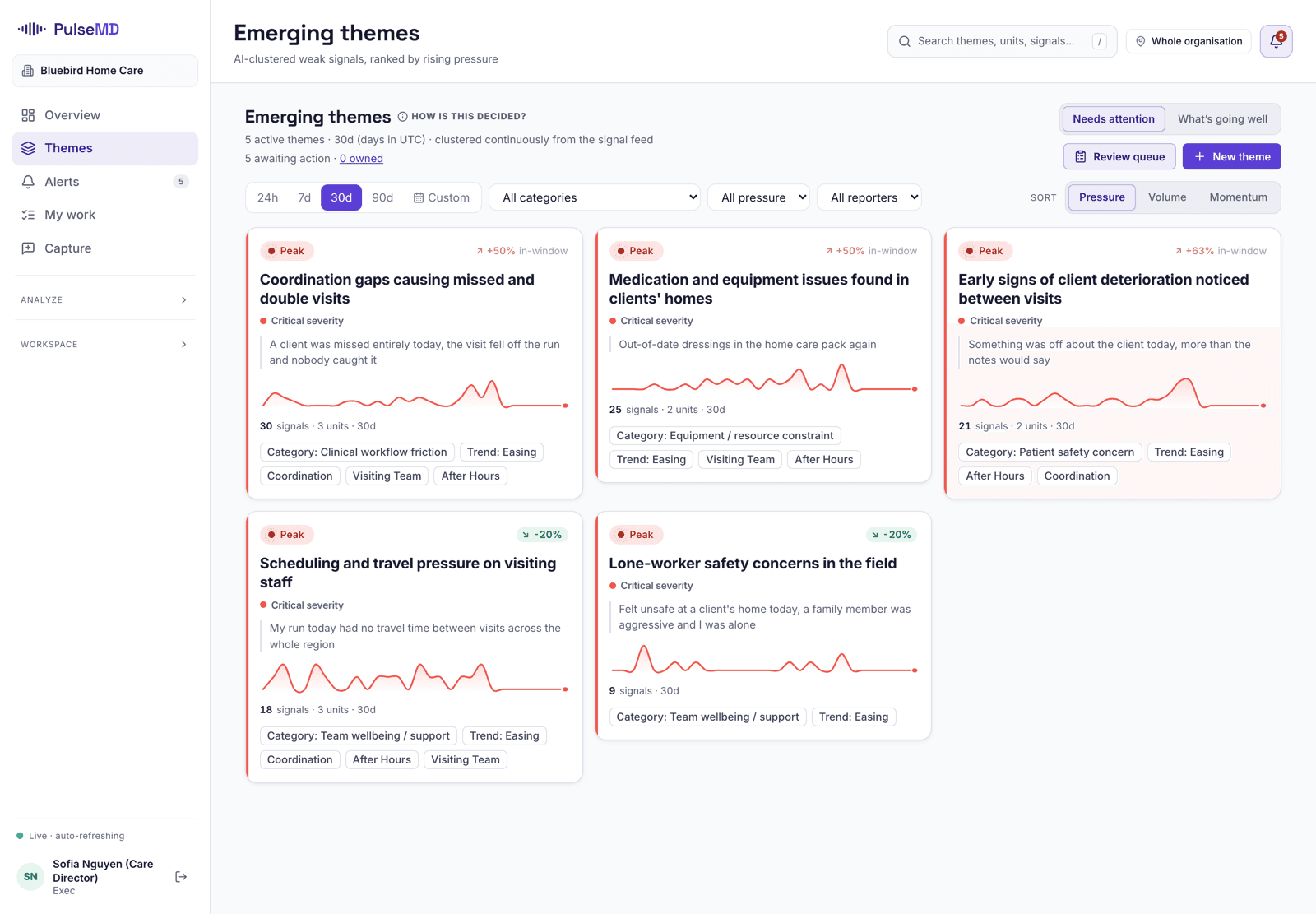
What becomes visible when people can share the moment.
A lightweight route for clients and families to share concerns, changes and good care while the context is still intact.
Changing wellbeing
A difference in mood, routine, comfort or participation noticed before the next formal review.
Communication
Conflicting answers, unexplained changes and gaps between what was expected and experienced.
Dignity and choice
Whether people were heard, included and given time to express what mattered to them.
Good care
Patience, kindness and sound judgement worth recognising and deliberately repeating.

On a visit, your staff see what no one else does.
A home that doesn’t feel right. A client who’s gone downhill since last week. A safety concern at the door. Working alone between visits, your field staff notice things that usually disappear before anyone hears them. PulseMD lets them share it in seconds from the doorstep, so the team coordinating care can act before the next visit, not after the call comes in.
What field teams see between visits
The inside operational context your field and visiting staff see first, brought alongside clients and families experience.
- Lone-worker safety concerns
- Coordination gaps and handover friction between visits
- Medication and equipment issues in the home
- Scheduling and travel pressure
- Early signs of a client deteriorating
Built for the community, in your language.
Patient, client or resident experience leads. Staff signal adds context. Repeated observations become a leadership pattern in the words your community uses.
Built for the field
Share a signal in seconds from a phone, anywhere, between visits, so the things noticed on the road don’t get lost.
Coordination visibility
Recurring friction across a region, surfaced as patterns the coordination team can act on early.
Client and family signals
A lightweight way for clients and families to flag concerns, captured as operational intelligence.
De-identified evidence your teams can take to the Care Quality Commission and the NHS.
Solutions for this setting
Workforce strain & retention
Pressure accumulates silently. By the time it shows up in a vacancy rate or an engagement survey, the cost is already paid.
ExploreOperational drift & throughput
Handover friction, bottlenecks and coordination gaps rarely trigger a formal report, they just quietly tax throughput and sustainability, every shift.
ExplorePatient & family voice
Patients, clients, residents, families and friends see the continuity of care across days, months and years. But formal processes ask them to save up what happened, after details soften, confidence fades and good care has gone unrecorded.
ExploreHear what people notice now, not what they can still remember later.
Start with patient and family voice in one setting, or combine it with staff signal from the beginning. Minimal-to-no integration, no workflow redesign and an honest pilot plan.
A senior member of our team responds the same business day. · Explore the Trust Center