Wellbeing
“Mum has been much quieter after dinner this week.”
Family · residential setting
PulseMD gives patients, clients, residents, families and friends a safe, simple way to share what they notice while the moment still matters, before context is lost, concern becomes complaint, or good care disappears without being seen.
Voice or text in seconds · no account friction · Privacy Act 2020-aligned · New Zealand data residency · works alongside your existing systems

“She was included in choosing her clothes today. It made an enormous difference.”
Built to sit upstream of the systems and governance processes you already trust.
“If it matters on Tuesday night, why do we wait until next month to ask about it?”
A routine changes. An answer conflicts. A kindness lands.
Details soften. Families hesitate. Good practice goes unrecorded.
A specific signal arrives as a vague score, or not at all.
Monthly and quarterly processes matter. Complaints and safeguarding channels matter. But they are not designed to preserve every small observation in context. Families may fear being identified or labelled difficult. Positive practice is easier to share, yet even that is often lost to time.
PulseMD creates a protected route for the quiet evidence between formal touchpoints.
A short observation keeps the detail that makes an experience useful. Concerns can surface earlier. Positive practice can be recognised and repeated.
Wellbeing
“Mum has been much quieter after dinner this week.”
Family · residential setting
Communication
“Three different people gave us three different answers about the appointment.”
Family · shared yesterday
Good care
“The night staff spoke to him with such patience when he was distressed.”
Friend · positive signal
Dignity & choice
“He was given time to finish what he was saying. That mattered.”
Family · client voice
Comfort & equipment
“Her chair still doesn’t fit comfortably at the dining table.”
Family · surroundings
Inclusion
“The team helped her plan the day around what she wanted to do.”
Family · practice worth repeating
The experience is deliberately light for the person speaking and deliberately structured for the people responsible for listening.
Share
10 to 20 sec voice or text
Cluster
AI themes the signals
Surface
Drift on one dashboard
Act
Intervene earlier
PulseMD helps leaders see what is recurring across a setting, service, shift or region while protecting the people behind the observations.
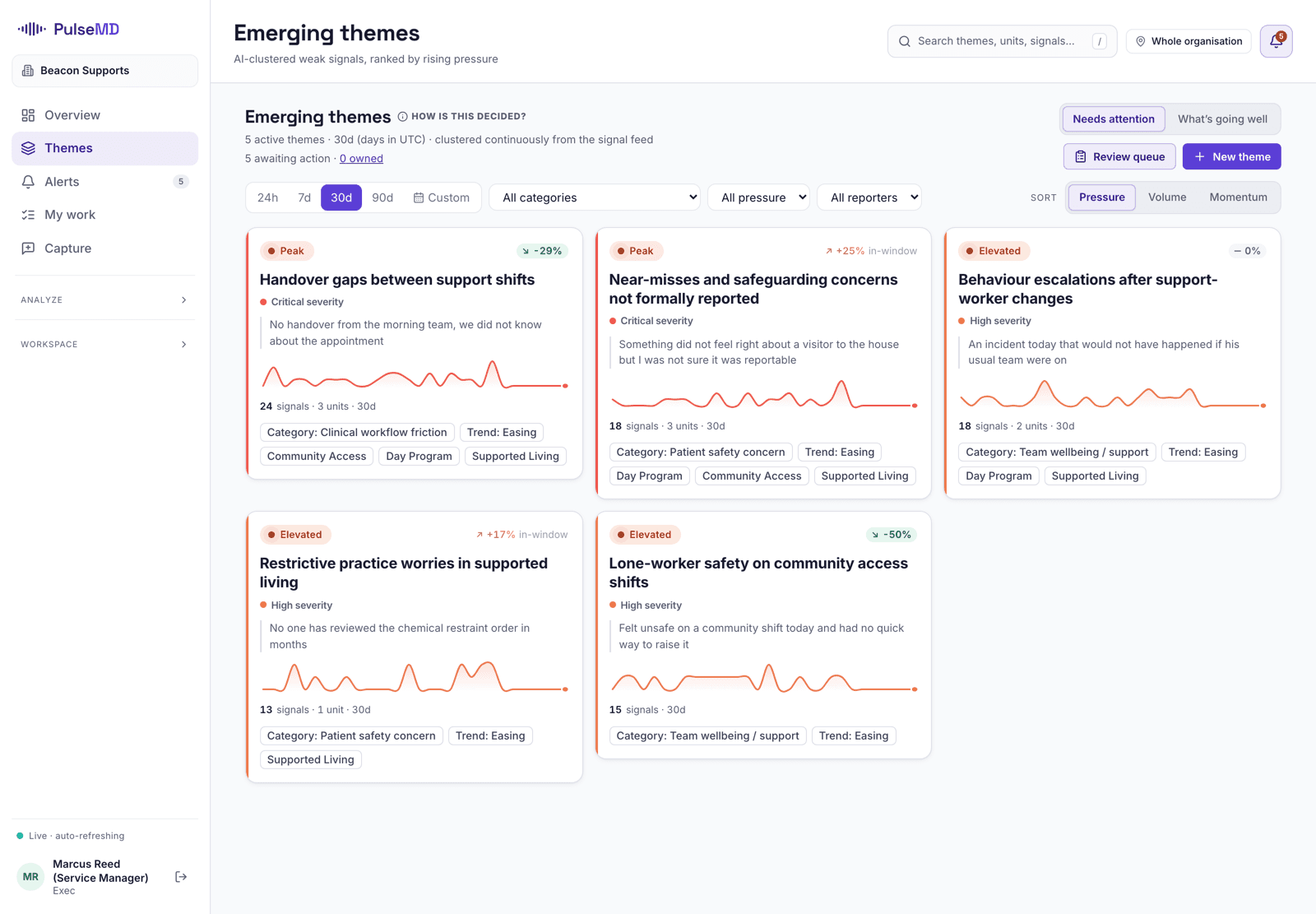
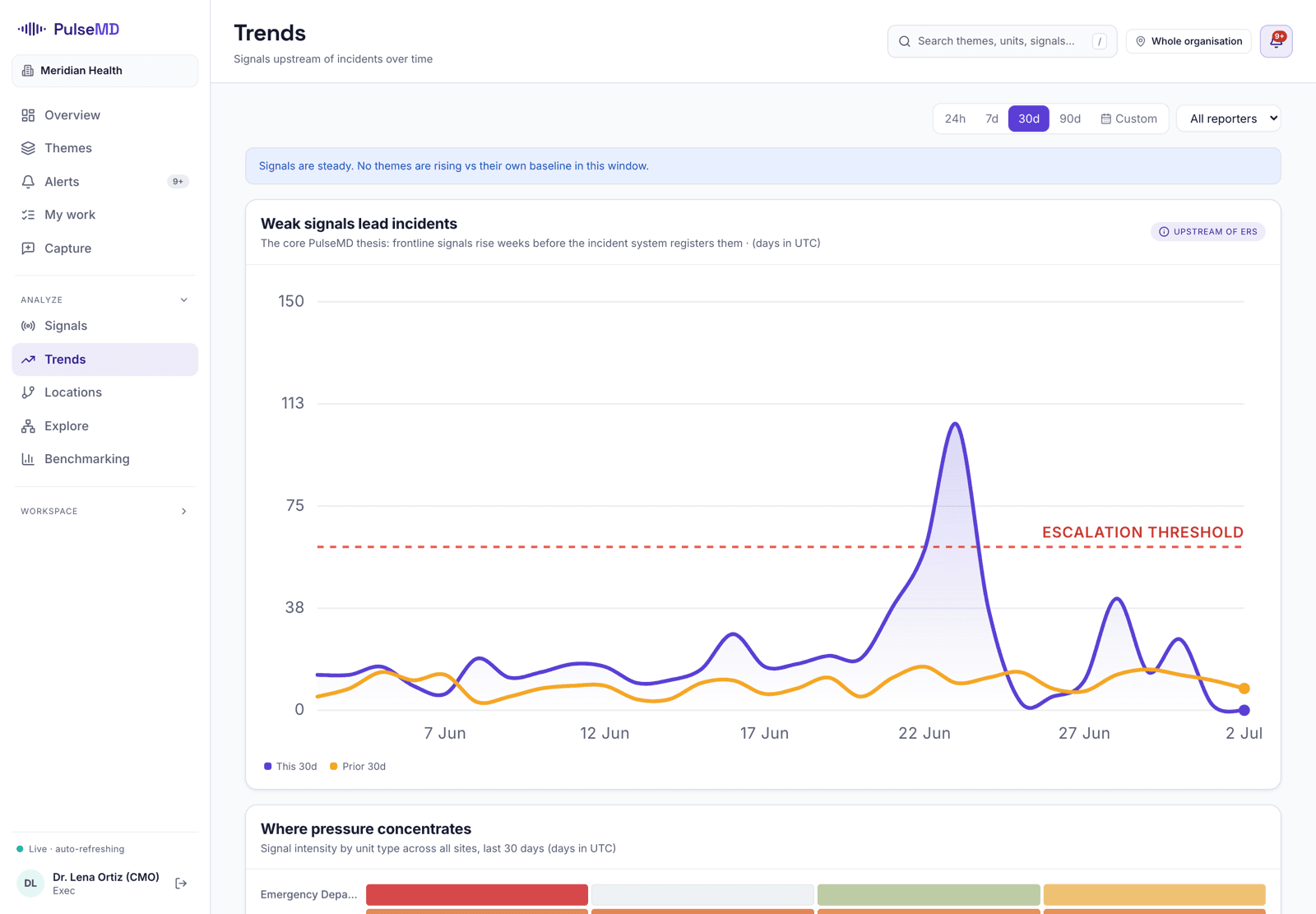
Communication gaps, changing routines, dignity, comfort and inclusion grouped across time.
Acts of patience, judgement and kindness made visible so strong practice can be repeated.
See whether ownership and intervention changed what people actually experienced.
The same protected example carries through capture, clustering and action while the complete product screens remain available around it.
PulseMD groups protected observations into the rising theme “Communication and routine changes”, with 14 signals across 3 services.

People receiving care experience the service. Families see continuity across days, months and years. Staff see the workarounds, pressures and near-misses inside each shift.
Together, those perspectives give leaders a truer operational view without turning voice into individual monitoring.
Outside-in signal
Experience, dignity, communication, continuity and trust.
Inside-out signal
Workflow friction, capacity, safety and team pressure.
PulseMD carries signal from the moment it is shared to the point where change can be seen and communicated.
Capture the observation while detail and context are intact.
Group recurring signals into a pattern leaders can review.
Assign ownership, agree the response and track movement.
Tell the community what changed and listen for what happens next.
PulseMD uses the words people use in each setting, from patients and residents to clients, families, friends and care teams.
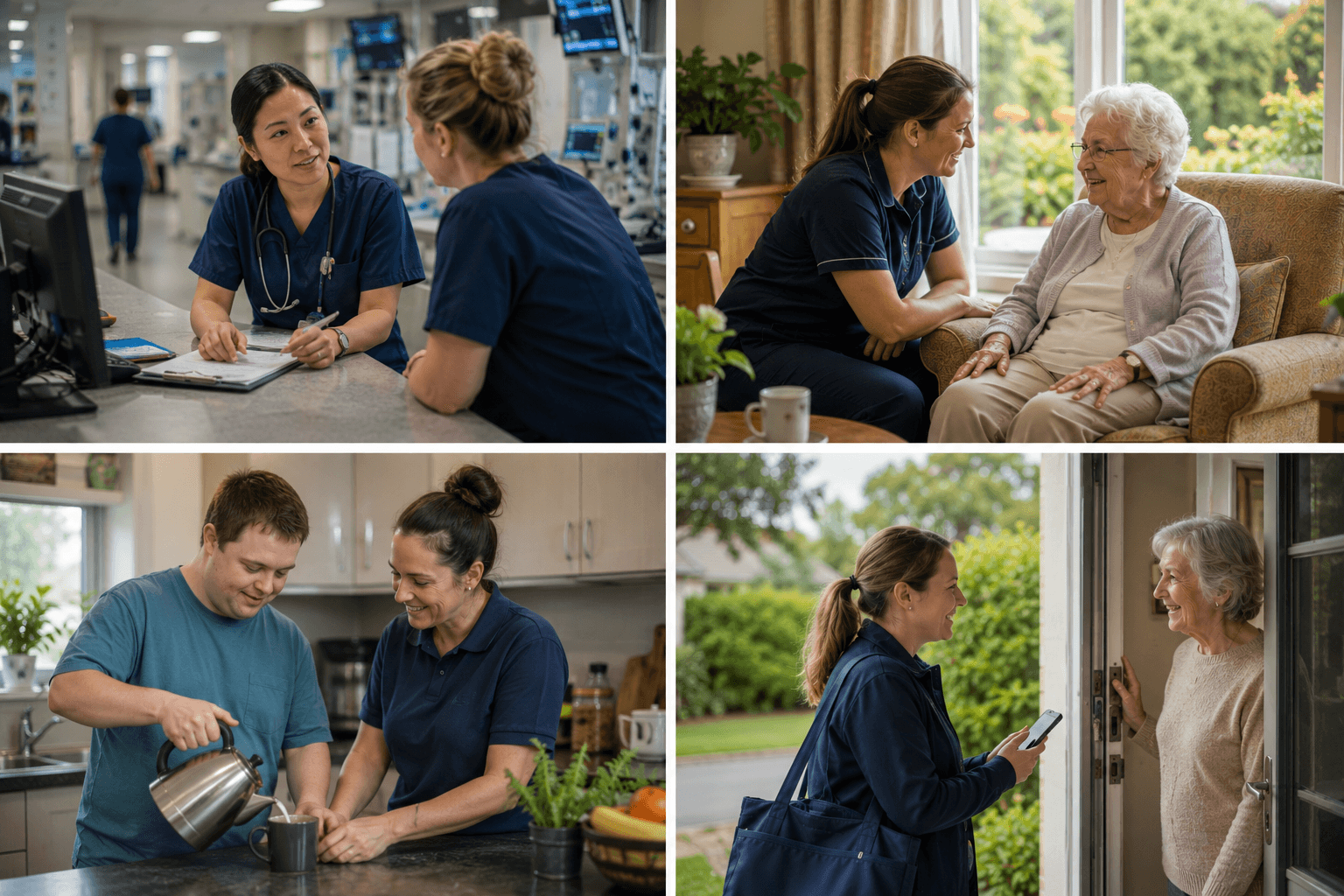
Wards, theatres, ED, discharge
ExploreResidential aged care, homes
ExploreSupported living, day programs
ExploreHome care, visiting teams
ExploreFor New Zealand hospitals, aged residential care, disability support and community care, from one service to a whole system.
Not another alert feed.
Every other system adds notifications. PulseMD does the opposite, it clusters recurring signals into a handful of meaningful trends, so leadership focuses on patterns, not fragments. Designed to identify meaningful operational patterns, not create more noise.
Every other system
142 alerts this month, each one a page
PulseMD
3 patterns, named and trending
PulseMD sits upstream of the incident report and alongside your EHR, your complaints and BI systems. It also gives patients and families a lightweight way to surface friction that never becomes a formal complaint, operational intelligence, not a satisfaction score. No major IT project. No workflow redesign. No disruption to existing reporting systems. Minimal-to-no integration required.
Patients · clients · residents · families · staff
a 10–20 second observation
PulseMD · early-signal layer
Themes, trends and drift, weeks earlier
Signals flow one way, into the systems you already run.
Every member of the committee gets a clear path from patient and family experience to the operational, clinical or technical evidence they own.
See the experience and operational pattern together
ExploreHear experience, safeguarding and near-miss signals early
ExploreA 10-second complement to ERS
ExploreShare what doesn’t feel right, heard early
ExploreCIO / CISO / CMIO, posture, data agreements, residency
ExplorePrivacy, restraint and transparent governance are part of the product, not language added after the fact.
What’s shared
“Nobody explained why Mum’s routine changed”
no name · no ID · no tracking
“She has been quieter after dinner this week”
no name · no ID · no tracking
“The night staff showed such patience”
no name · no ID · no tracking
What leadership sees
Communication and wellbeing
unit-level theme · 14 signals · rising
Theme below 5 voices
stays hidden until enough people say it · k-anonymity
De-identified and aggregated at the unit and theme level. Never identifies a person.
Leadership visibility is designed around grouped operational patterns, not individual reporters.
PulseMD is not designed to rank, track or score patients, families or staff.
Safeguarding, complaints, incidents and emergencies keep their established routes.
Role-based access, defined retention and region-specific handling are documented for each deployment.
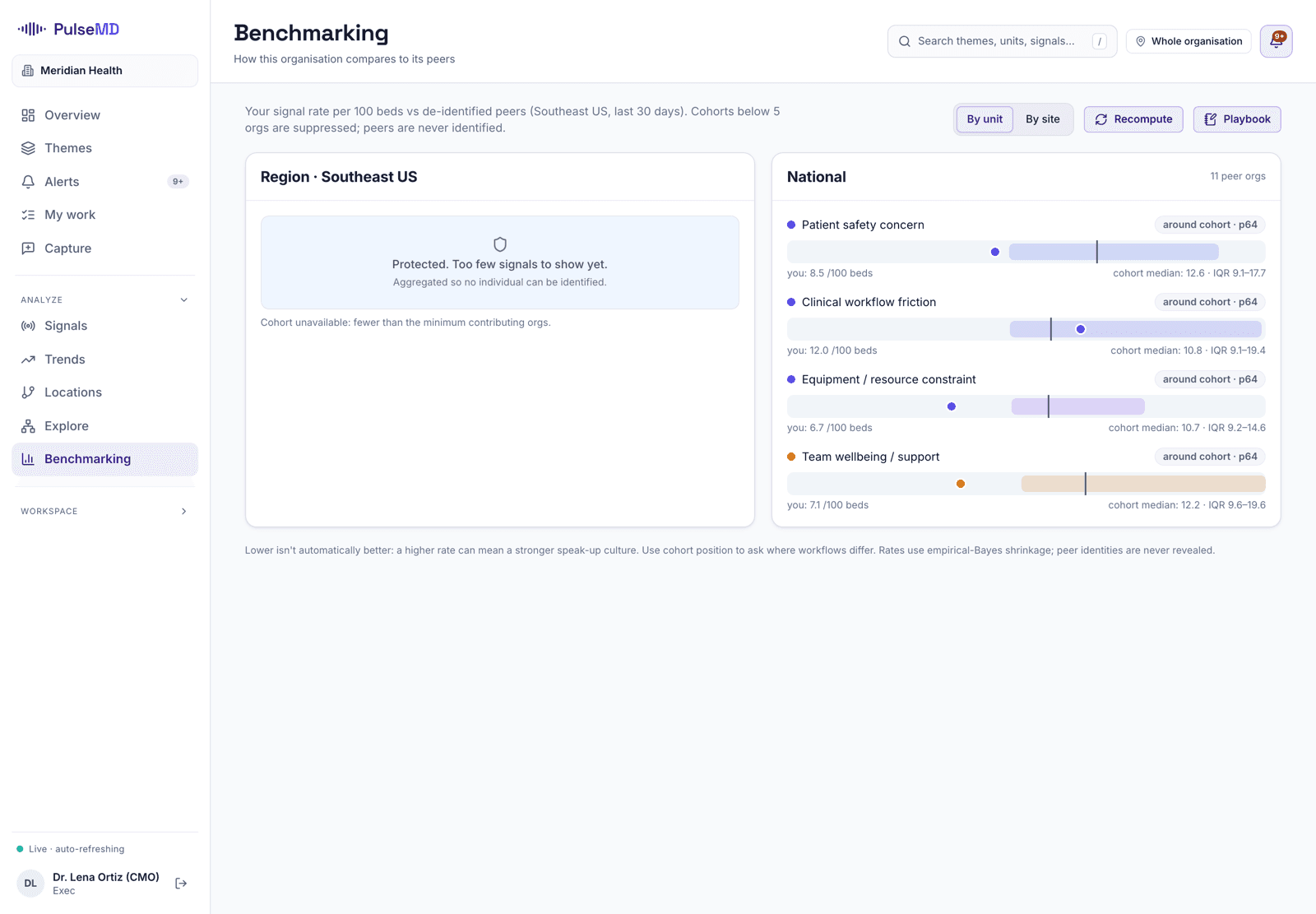
From a single unit to regional, state and national benchmarking, compare facilities, find what good looks like, and learn why. PulseMD becomes your organizational learning layer.
Compared inside de-identified cohorts. Peers are never named.
“One comment is an experience. Repeated signal is operational intelligence.”
Start with one setting
Start with one setting and establish the right language, access points, governance and success measures with patients, clients, families, staff representatives and service leadership.
A senior member of our team responds the same business day.