Catch operational drift while it’s still small.
Handover friction, bottlenecks and coordination gaps rarely trigger a formal report, they just quietly tax throughput and sustainability, every shift.
On the home-care run
“A client was missed entirely today”
Visiting Team
“No travel time between visits again”
Coordination
“Felt unsafe on a visit, I was alone”
After Hours
one theme · 3 units · rising
The same early signal, wherever care happens.
Operational drift & throughput shows up on a ward, in a care home, in supported living and out in the community. PulseMD catches it the same way in each, in the words your teams use. Pictured: Community & home care.
Stop measuring the receipt. Start seeing the signal.
What you see today, lagging
Length-of-stay creep and throughput metrics, visible only once the drift has compounded.
What PulseMD shows, leading
The recurring friction itself, named, counted and trending, weeks before it shows in the numbers.
The signals that matter here.
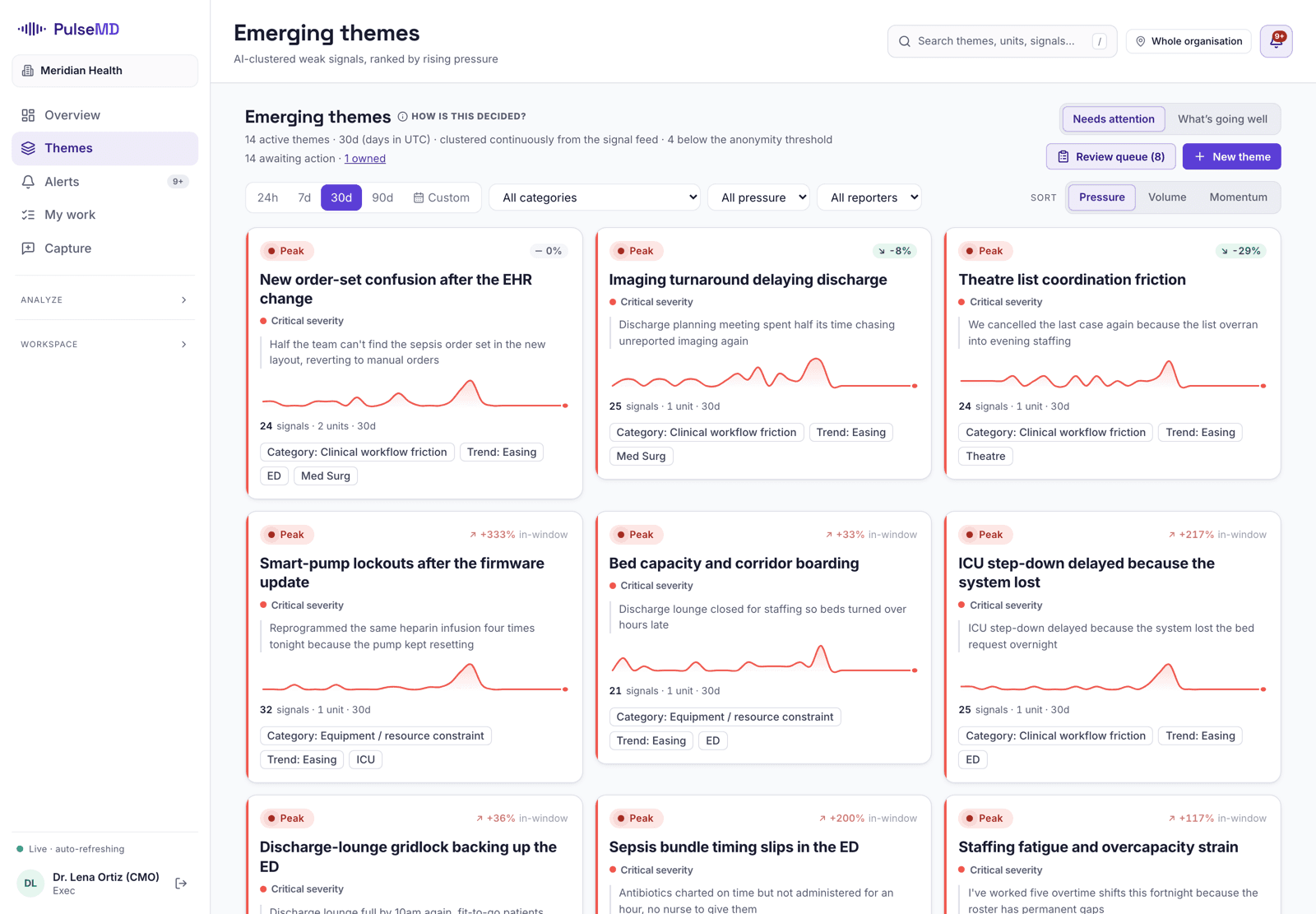
“Operational drift” is the slow movement away from how work is supposed to run. PulseMD makes it visible as an early, acting-able pattern.
Complements your existing systems, no major IT project, no workflow redesign, minimal-to-no integration.
Hear what people notice now, not what they can still remember later.
Start with patient and family voice in one setting, or combine it with staff signal from the beginning. Minimal-to-no integration, no workflow redesign and an honest pilot plan.
A senior member of our team responds the same business day. · Explore the Trust Center