What formal complaints reveal, and what they arrive too late to show
Complaints tell healthcare organisations where care failed expectations badly enough for someone to pursue a formal response. The smaller observations that came first often remain invisible.

A complaint carries weight for good reason
A person who makes a formal complaint has usually spent time deciding whether to proceed. They may have repeated the story, gathered dates, found the right office and accepted the emotional cost of returning to a difficult experience. The organisation owes that person a serious response.
Complaint systems protect rights, establish accountability and create a documented route for resolution. They can expose failures that other sources miss. They also contain detail about the relationships and operational conditions around care, not only the clinical event at the centre of the case.
Reader, Gillespie and Roberts found exactly that breadth in their review of 88,069 complaints. The underlying issues divided almost evenly across clinical, management and relationship domains. Communication, treatment, access, institutional processes and staff-patient relationships all appeared in the data. 1
The formal threshold shapes the evidence
Complaint data represents people who crossed a threshold. Some had a severe experience. Some had the time, confidence and knowledge to navigate the process. Others wanted an explanation or assurance that the same thing would not happen again. Many people who noticed friction never entered the system.
That selection does not weaken the complaint. It defines what the data can answer. Complaints can show serious and recurring problems among the people who complained. They cannot estimate how often every patient experienced the same issue, and they do not describe all the smaller moments that preceded a formal concern.
The same caution applies to voluntary incident reports. AHRQ describes both selection bias and under-reporting in event-reporting systems. Reports identify concerns worthy of attention, but they cannot supply the denominator needed to estimate prevalence. 6

Communication and treatment dominate the complaint literature
Across the studies in Reader and colleagues’ review, treatment represented 15.6 percent of coded complaint issues and communication 13.7 percent. When the authors recoded the material into a common taxonomy, 39 percent of issues fell into treatment and communication together. Safety issues were also prominent where studies coded them explicitly. 1
Communication is easy to classify as a “soft” experience problem. In practice, an unexplained change, conflicting advice or a handover gap can affect trust, adherence and a person’s ability to participate in care. Doyle and colleagues found patient experience associated with adherence, preventive care, resource use and some safety measures across a broad research base. 2
The operational question is precise: how can a team hear communication friction while the people involved still remember who said what, when it happened and what remained unclear? A complaint may eventually provide that detail. A short earlier observation can preserve it before escalation becomes necessary.
Earlier voice should not become an informal complaints system
A lightweight channel needs a clear boundary. Safeguarding concerns, emergencies, allegations, formal grievances and incidents must continue into their established routes. A person sharing an early observation should understand what the channel is for, what will happen to their words and where urgent matters belong.
The organisation also needs a response policy. Some signals require immediate human review. Others contribute to an aggregated pattern. Positive observations can identify practice worth repeating. A short form is easy to launch; a safe operating model takes more care.
Hiding formal routes in the hope that early feedback will reduce complaint numbers would corrupt the purpose. The useful aim is earlier listening and better action, while keeping rights-based processes visible and intact.
Collection creates a second problem: analysis
Complaint analysis varies widely. Reader and colleagues found 205 analytical codes across 59 studies, inconsistent methods and limited evidence about coding reliability. 1 A separate review of patient-experience feedback found 37 types of feedback and concluded that routinely available sources often served accountability better than ward-level improvement. 3
Narrative data needs enough structure to reveal recurrence without stripping away the detail that made the account useful. A practical model preserves the original observation, groups related material, records setting and time, and lets reviewers inspect why a theme exists.
Counts help decide where to look. They should not be read as prevalence rates unless the collection method supplies a meaningful denominator. A theme with five observations may matter greatly, but it does not mean five percent of patients experienced the issue.
Complaint numbers are a poor target on their own
An organisation can reduce recorded complaints by making the route difficult, discouraging escalation or resolving concerns informally without learning from them. It can also increase complaints by making rights clearer and building confidence in the process. The number needs context.
The same problem affects targets for early observations. A pilot that rewards high submission volume may produce noise and pressure staff to promote the channel. A pilot that rewards low concern volume may teach teams to suppress difficult feedback. Process measures should focus on access, review quality, response time and follow-through.
Wong and colleagues found limited high-quality evidence about patient-feedback-informed interventions, even though multi-component approaches appeared more promising. Gleeson and colleagues also found that experience data often supported small incremental changes. Those findings favour measured tests over outcome claims based on volume alone. 4, 5
Earlier voice needs a visible handoff to formal routes
People do not organise their experiences according to the institution’s systems. One short observation may contain dissatisfaction, a possible incident and a request for an explanation. The organisation has to manage that overlap without asking the contributor to become an expert in policy.
Capture instructions should name urgent and formal routes before submission. Review guidance should state when an early observation is forwarded, who receives it and what information can travel. If the collection model removes identity, the organisation should explain how that limits individual follow-up.
The cleanest model keeps the original purpose intact. Early voice helps reveal recurrence. Complaints establish a formal right to response. Incident and safeguarding systems carry defined duties. A handoff connects those purposes without merging them into one ambiguous queue.
A practical evidence map keeps the routes distinct
Consider a family member who says that a resident received different explanations about a medication change. The early observation belongs in the pattern view because it may recur. If the account alleges harm or requests a formal response, it may also need a complaint or incident pathway. Routing the second purpose should not erase the first.
The review record can show three things separately: the observation as received, any formal route used, and the aggregated theme to which it contributed. Access should follow purpose. A complaints investigator may need case detail that a broader operational group should not see. The operational group may need the recurrence without the identity.
This separation also improves communication. The individual receives information through the formal route where possible. The wider community can hear that the organisation reviewed a communication theme and changed a process. Neither message needs to reveal the other. A clear map between evidence and duty is safer than one universal inbox.
Where PulseMD fits
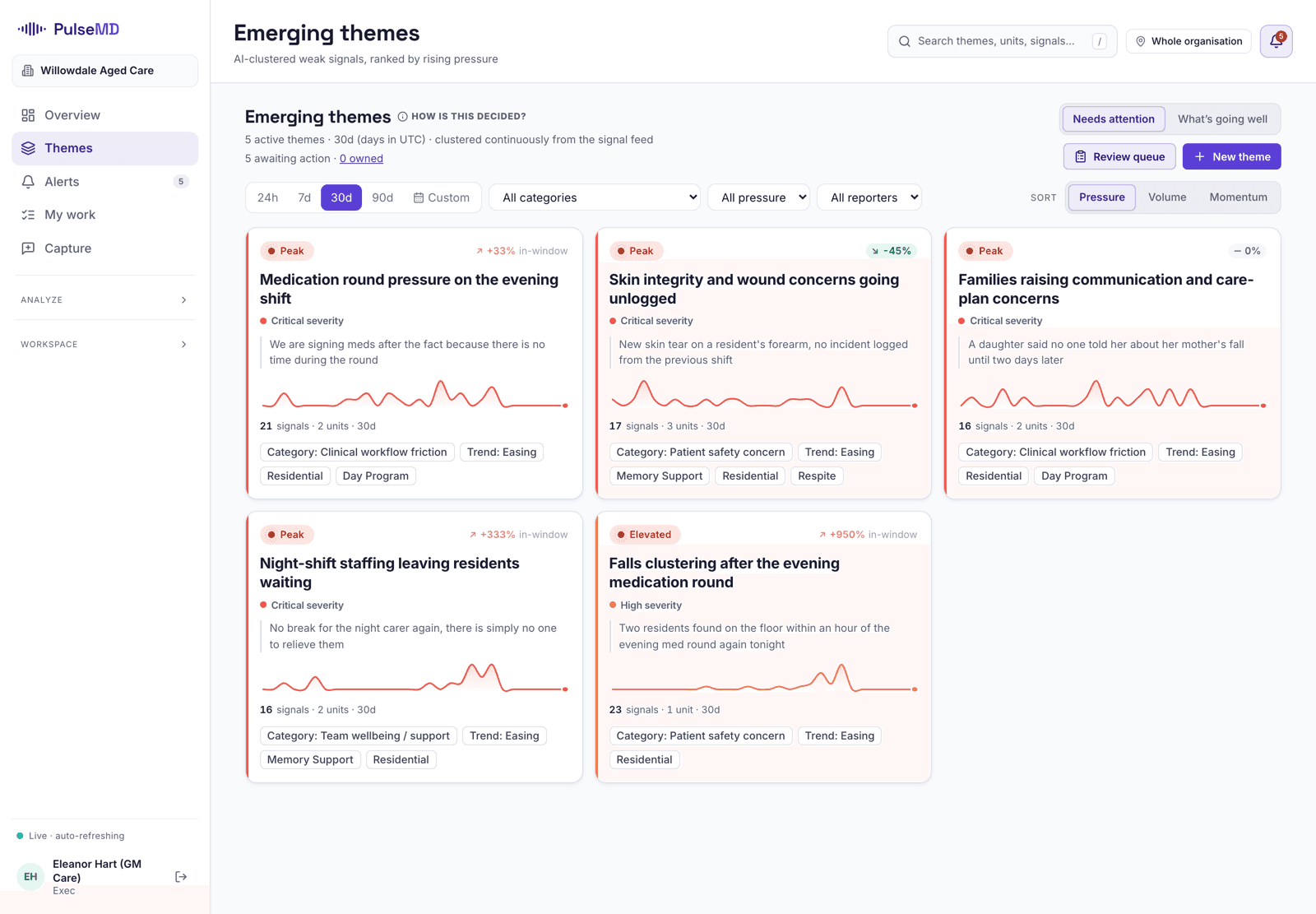
PulseMD sits before the complaint threshold. Patients, residents, clients, families and friends can share a short observation while the moment is still clear. Repeated observations become themes that leaders can review alongside staff signal and existing quality data.
PulseMD does not adjudicate complaints, investigate allegations or replace the organisation’s formal process. It does not promise that earlier capture will prevent a complaint. It gives the organisation a chance to see recurring friction and good care before those experiences disappear into memory.
The strongest pilot keeps the distinction visible on every capture surface. People should know how to make a complaint, report an incident or raise an urgent safeguarding concern. Trust depends on the organisation making all of those routes easier to understand.
References
- 1.Reader TW, Gillespie A, Roberts J. “Patient complaints in healthcare systems: a systematic review and coding taxonomy.” BMJ Quality & Safety, 2014. Original source
- 2.Doyle C, Lennox L, Bell D. “A systematic review of evidence on the links between patient experience and clinical safety and effectiveness.” BMJ Open, 2013. Original source
- 3.Sheard L, Peacock R, Marsh C, Lawton R. “Patient experience feedback in UK hospitals: What types are available and what are their potential roles in quality improvement?.” Health Expectations, 2019. Original source
- 4.Gleeson H, Calderon A, Swami V, Deighton J, Wolpert M, Edbrooke-Childs J. “Systematic review of approaches to using patient experience data for quality improvement in healthcare settings.” BMJ Open, 2016. Original source
- 5.Wong E, Mavondo F, Fisher J. “Patient feedback to improve quality of patient-centred care in public hospitals: a systematic review of the evidence.” BMC Health Services Research, 2020. Original source
- 6.Agency for Healthcare Research and Quality. “Reporting Patient Safety Events.” Patient Safety Network, 2025. Original source