Patients, families and staff see different parts of the same care system
Patients experience the service. Families see continuity across time. Staff see the work required to deliver care. Each perspective catches details the others cannot.

The patient sees the whole journey from one position
A patient moves through admission, assessment, treatment, transfer and discharge as one experience. The organisation often divides that journey across teams, records and accountability structures.
The patient can describe whether explanations connected, whether they knew what would happen next and whether choices felt real. They may not see the staffing constraint, competing emergency or technical rule behind the moment.
Doyle and colleagues’ review supports patient experience as a central quality domain associated with safety and effectiveness measures. The review also shows the variation in how experience is defined and measured. 1
Families often hold the continuity
A family member may see the same person across months, shifts and services. They notice changes in routine, mood, comfort and communication. In aged care, disability support and home care, that continuity can extend far beyond one clinical encounter.
WHO’s Patients for Patient Safety programme argues for patient and family voice throughout the care system. AHRQ’s engagement guide includes partnership in bedside communication, handover and discharge, all points where continuity can break. 2, 3
Family observations need the same careful boundaries as other evidence. They can identify an experience or concern. Clinical assessment remains with qualified professionals, and urgent deterioration needs the established care route.
Staff see the system from inside the work
Staff see the missing equipment, duplicated task, queue, workaround and pressure at shift change. They also see which routines protect care when demand rises.
High-reliability thinking values sensitivity to operations and deference to expertise. AHRQ notes that implementation is uneven and that hierarchy can weaken the application of these principles. 4
Frontline voice should not be mined as a substitute for proper staffing, observation and leadership presence. A capture route adds another source. Leaders still need to spend time where care happens and involve teams in interpreting patterns.
Convergence is a prompt to investigate
Families report conflicting explanations. Staff report handover gaps. Patients report uncertainty about the plan. The three themes may share an operational cause. Their movement together makes the question more urgent, but it does not establish causation.
Reviewers can examine timing, setting, staffing, formal events and local process. They can ask whether the categories were promoted equally and whether one source dominates because it was easier to access.
Keeping each stream identifiable protects interpretation. Combining everything into one score would hide whose experience changed and which part of the system they could observe.
Participation will never be neutral
Access, language, disability, digital confidence, fear and trust affect who speaks. A QR code may work well for some people and exclude others. Voice capture may help somebody who finds typing difficult and create a barrier for somebody without privacy.
Organisations should offer more than one route and monitor participation by setting without turning contributors into targets. Patient and family advisors can help test language, placement and instructions before launch.
AHRQ developed its engagement guide with input from patients, families, clinicians and administrators and pilot-tested it at three hospitals. That co-design principle matters for any new listening route. 3
Disagreement between perspectives is useful
Staff may believe communication was clear while families report confusion. Patients may value a process that staff experience as inefficient. Those differences should not be averaged away.
Disagreement can reveal a handoff between professional logic and lived experience. Reviewers can inspect where expectations diverged and whether one group lacked information available to another.
Complaint research shows how clinical, management and relationship issues overlap inside one account. Preserving the perspective of the contributor helps teams understand which part of that overlap they are hearing. 6
Engagement is more than a collection channel
Berger and colleagues reviewed patient and family engagement strategies intended to reduce adverse events in acute care. The practices ranged from reporting concerns to active partnership. The evidence was varied, but the distinction matters: asking for comments is a narrow form of participation. 5
Advisory groups, bedside partnership, shared decisions and co-design involve patients and families in different ways. A signal channel should support those relationships rather than become the organisation’s only proof of engagement.
Leaders can invite advisors to review themes, test language and challenge planned responses. That role requires support, consent and clarity about confidential information.
Care settings require different language and routes
Hospitals use patients, wards and discharge. Aged care uses residents, homes and routines. Disability support may use clients, participants and supported living. Community care follows people across visits and locations.
Copying one capture model across those settings can make the channel feel foreign or unsafe. The examples, categories and formal escalation links should use the words people already know.
The underlying mechanism can stay consistent: preserve a short observation, protect the contributor according to the agreed model, find recurrence and connect the theme to human review.
A convergence example should retain three accounts
Imagine patients saying they do not know who is coordinating discharge, families describing repeated calls for updates and staff reporting that responsibilities move between two teams. The overlap makes coordination a reasonable subject for review. It does not mean every account describes the same event.
The reviewer should preserve each stream, compare timing and setting, and ask the teams how ownership currently works. A process map may show an unclear handoff. It may also show that the formal process is clear but poorly explained to patients and families. Those findings require different responses.
Board reporting can show the convergence without manufacturing one number. A short pack might present the three themes, participation limits, relevant operational context, the process question under review and the named owner. On the next cycle, it can report what changed and what each evidence source did afterwards. Keeping the accounts distinct makes the shared pattern easier, not harder, to understand.
Where PulseMD fits
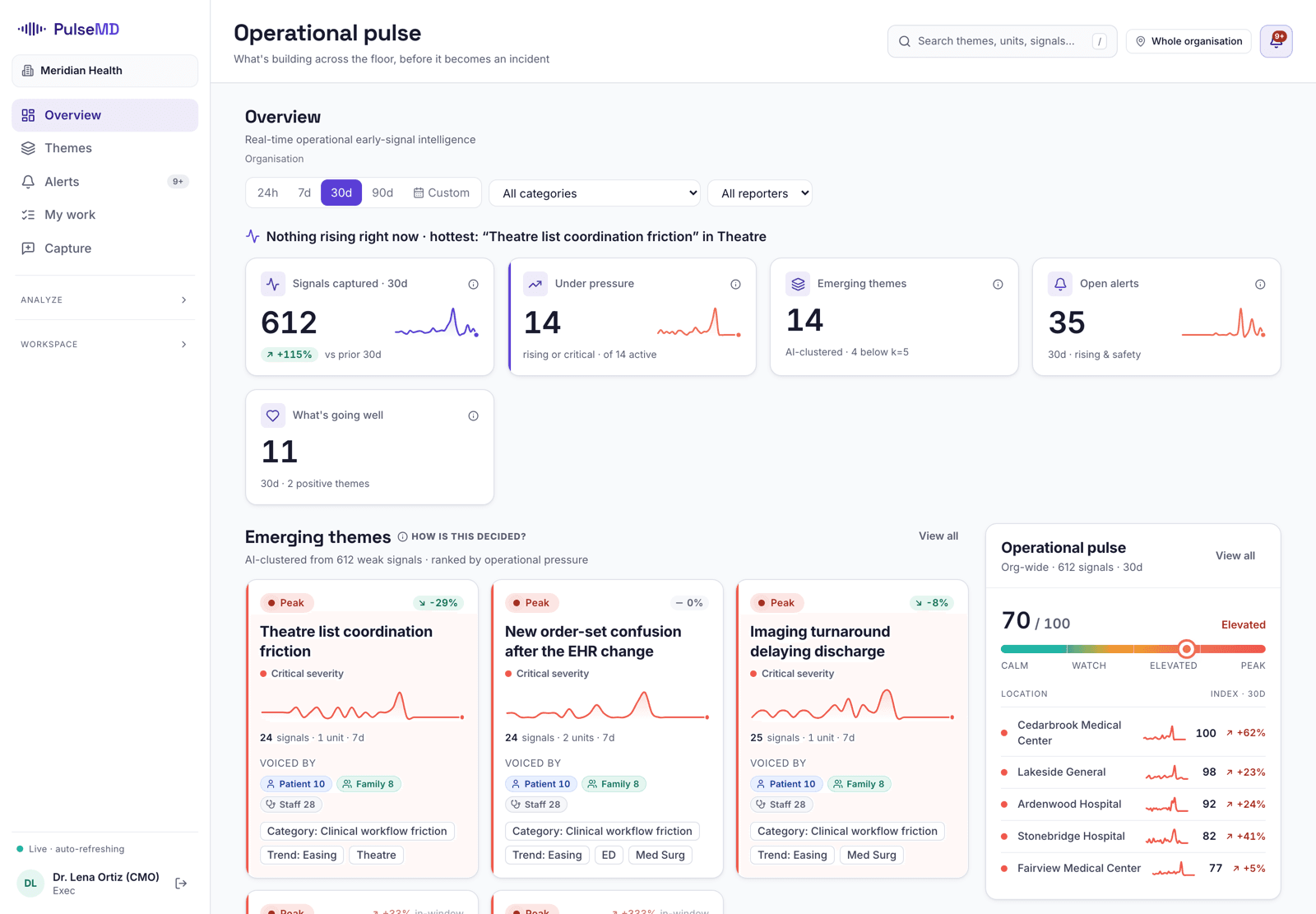
PulseMD begins with patient, client, resident and family voice. Staff signal adds the inside operational view. The product groups repeated observations and lets leaders review how themes move across settings and time.
The two streams remain distinct. PulseMD does not use patient comments to score staff or use staff signal to invalidate experience. It does not replace advisory councils, rounding, complaints, surveys or direct leadership contact.
A credible implementation decides whose voice is missing before it measures volume. Teams should test access with the people expected to use the channel and adjust the capture model when participation tells an unequal story.
References
- 1.Doyle C, Lennox L, Bell D. “A systematic review of evidence on the links between patient experience and clinical safety and effectiveness.” BMJ Open, 2013. Original source
- 2.World Health Organization. “Patients for Patient Safety.” World Health Organization, 2025. Original source
- 3.Agency for Healthcare Research and Quality. “Guide to Patient and Family Engagement in Hospital Quality and Safety.” Agency for Healthcare Research and Quality, 2023. Original source
- 4.Veazie S, Peterson K, Bourne D. “High Reliability Organization Principles and Patient Safety.” AHRQ Patient Safety Network, 2025. Original source
- 5.Berger Z, Flickinger TE, Pfoh E, Martinez KA, Dy SM. “Promoting engagement by patients and families to reduce adverse events in acute care settings: a systematic review.” BMJ Quality & Safety, 2014. Original source
- 6.Reader TW, Gillespie A, Roberts J. “Patient complaints in healthcare systems: a systematic review and coding taxonomy.” BMJ Quality & Safety, 2014. Original source