Why patient experience belongs in the safety and quality conversation
A patient experiences the handover, the delay, the conflicting explanation and the kindness that restored confidence. Those moments are evidence. They need careful interpretation, not a satisfaction label.

A view of care that the clinical record cannot hold
A clinical record is built for clinical work. It records assessment, treatment, medication, observations and decisions. An incident system records defined safety events. Operational systems record activity, staffing, flow and finance. Each serves a clear purpose. None can reconstruct how care felt across the whole journey.
Patients and families see the joins. They hear one explanation on Monday and another on Tuesday. They notice that a routine changed without warning, that discharge instructions made sense only after a second conversation, or that a nurse took time to include someone who was frightened. These observations sit at the boundary between experience, operations and safety.
The World Health Organization places patients and families inside the work of safer care, not outside it. Its Patients for Patient Safety programme argues for patient and family voice at every level of the system. AHRQ takes a similar position in its guide to patient and family engagement, which covers communication, bedside handover, discharge and partnership in improvement. 2, 3
Experience
What care felt like
Communication, dignity, continuity and confidence
Operations
What shaped the moment
Handover, workload, equipment and coordination
Clinical
What the record contains
Assessment, treatment, outcomes and formal events
What the research supports
Doyle, Lennox and Bell reviewed 55 studies across primary and secondary care. Positive patient experience was associated with a range of safety and clinical-effectiveness measures, including adherence, preventive care, resource use and some adverse-event measures. Positive associations appeared more often than null associations. 1
That finding makes a serious case for patient experience as one pillar of quality. It does not show that better experience scores cause better clinical outcomes. The studies used different measures, settings and designs. Evidence relating specifically to safety was thinner than evidence relating to effectiveness, and the authors called for more research.
A separate systematic review of patient and family engagement in acute care found a broad set of practices, from reporting concerns to partnership in care. The evidence base was heterogeneous. Some interventions showed promise, but the mechanisms and outcomes were not consistent enough to support sweeping claims. 4
Experience is more useful when the moment still has context
Timing changes what a person can tell you. A quarterly survey may be the right instrument for comparison, accountability or a validated measure. It asks people to reconstruct events after detail has faded. A complaint captures issues serious enough for someone to enter a formal process. A short observation made near the moment preserves a different kind of information.
That observation can be modest: nobody explained the delay; three staff members gave different answers; the new evening routine left a resident unsettled; a support worker found a way to include a client in a decision. A single comment cannot establish prevalence or causation. It can identify a question worth asking.
The practical opportunity lies in repeated observations. Several comments about conflicting explanations, made across different days or units, carry more operational meaning than an isolated score. Leaders can examine where the pattern concentrates, what else changed and whether the same theme appears in staff signal.

Complaints show why experience data needs structure
Reader, Gillespie and Roberts reviewed 59 studies covering 88,069 complaints and 113,551 underlying issues. They grouped the issues into clinical, management and relationship domains. Treatment and communication were the most common subjects, and safety accounted for a material share where researchers coded it. 5
The review also found inconsistent coding. Studies used 205 different analytical codes, applied them at different levels and often lacked reliability data. The lesson extends beyond complaints. Collecting narrative text creates work: deciding what it means, preserving nuance, separating a recurring pattern from an emotionally powerful outlier, and making the analysis reviewable.
Automation can help group similar observations, but human judgement remains responsible for meaning and action. A named theme is a prompt for review. It is not a clinical conclusion, a finding about an individual or proof that an intervention is needed.
Specific feedback is easier to act on
Baines and colleagues reviewed how patient feedback affected doctors’ performance. Feedback was more likely to influence behaviour when it was specific, credible, supported by narrative information and discussed in a setting that allowed reflection. Organisational culture and facilitation shaped whether the data led anywhere. 6
“Communication needs improvement” is difficult to own. “Families received different explanations about the evening routine on three wards this week” gives a team somewhere to begin. It still needs validation. Leaders can look at the source setting, speak with staff, check related measures and decide whether the pattern warrants action.
This is why experience work belongs close to operations. Patient-experience teams can interpret the human meaning. Clinical and quality leaders can assess safety relevance. Operational leaders can see workflow and capacity. Frontline teams can explain the conditions behind the pattern.
Representation changes the meaning of the data
Every listening method reaches some people more easily than others. A QR code at the bedside assumes a phone, connectivity, privacy and enough confidence to use it. Voice may reduce the burden of typing and create a new barrier for a person who cannot speak privately. Family participation varies with visiting patterns, distance and the nature of the care setting.
Leaders should review participation before interpreting theme volume. A service with more observations may have stronger promotion rather than more problems. A group with little voice may face access barriers rather than uniformly good care. Participation data can expose those differences without collecting more personal information than the programme needs.
Patient and family advisors can test prompts, placement, language and escalation instructions. AHRQ’s engagement guide was developed with input from patients, families, health professionals and administrators, then pilot-tested in hospitals. That process is more credible than asking a project team to predict how every person will understand the channel. 3
Boards need interpretation, not a larger count
A board report should separate activity, pattern and outcome. Activity includes who was invited, how many observations arrived and how quickly teams reviewed them. Pattern describes recurring themes, settings and movement. Outcome requires evidence that a response changed something meaningful.
Those distinctions prevent a common error: treating more reports as worse care or fewer reports as safer care. Volume can rise because access improved, leadership promoted the route or trust increased. It can fall because a problem resolved, participation faded or people stopped believing the channel mattered.
A useful governance pack includes representative de-identified observations, limitations in participation, links to related formal data and the actions under review. It should state where the organisation cannot draw a conclusion. Restraint makes the stronger findings easier to trust.
Triangulation is a review method, not a hunt for agreement
Suppose families repeatedly describe rushed discharge explanations. The experience data establishes that those accounts were received. Reviewers might then examine discharge timing, readmission measures, staffing, formal complaints and comments from the clinical team. Each source can support, complicate or challenge the first interpretation.
The sources do not need to agree before the family observations matter. A clinical record may show that every required instruction was documented while several people still report leaving without confidence. The gap could sit in timing, language, stress or the difference between providing information and establishing understanding.
A disciplined review records the original question, the evidence checked and the decision reached. It avoids searching only for material that confirms the first theme. When the sources conflict, the disagreement is itself useful: it tells the team where its formal account of care and the lived account have separated.
Where PulseMD fits
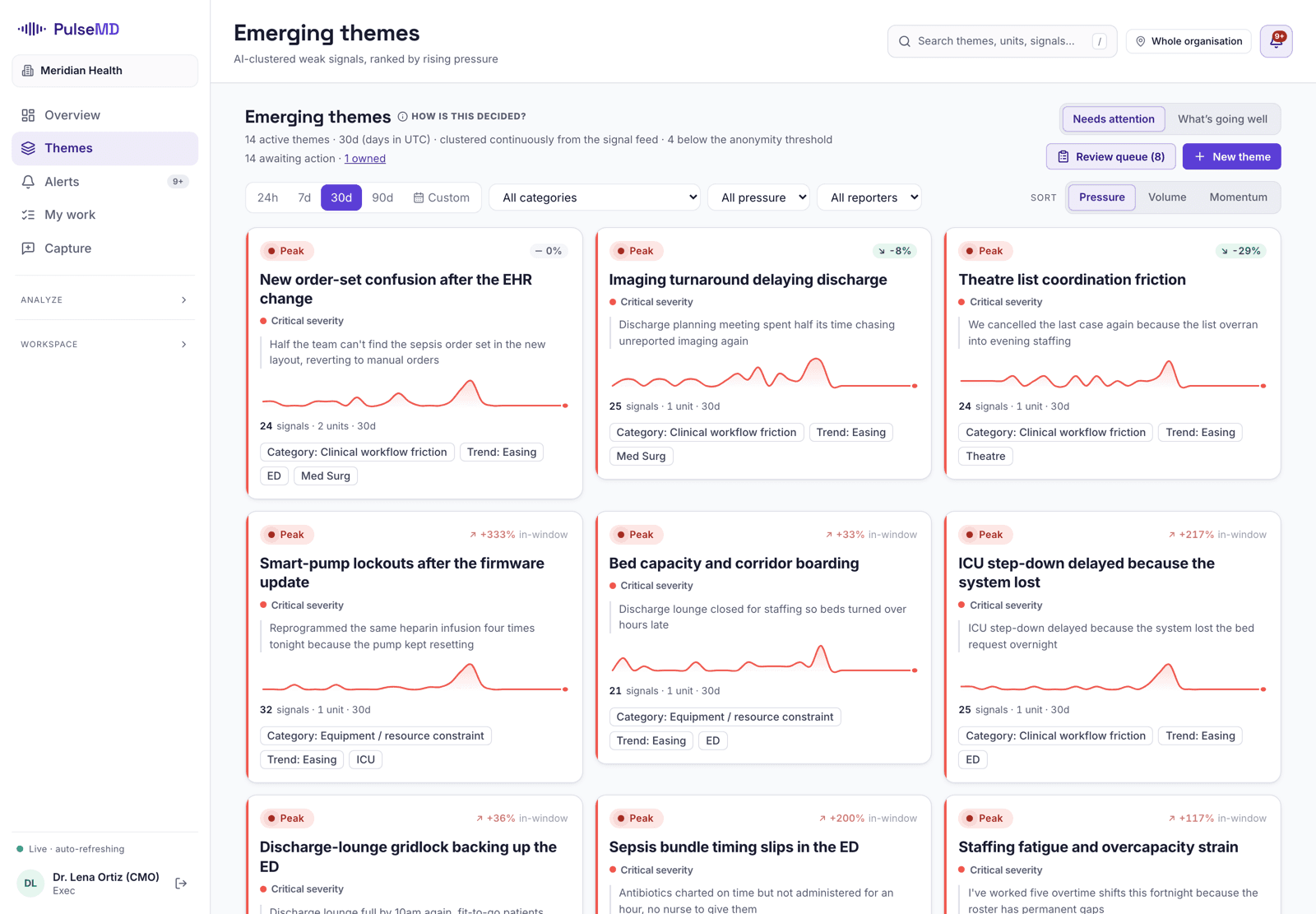
PulseMD gives patients, clients, residents, families and friends a short voice or text route to share what they notice. It groups repeated observations into protected themes and shows their movement over time. Staff signal can sit alongside that outside-in view, adding context about workload, handover, equipment and coordination.
The product does not replace clinical records, validated experience measures, complaints, safeguarding routes or incident reporting. It does not diagnose harm or determine whether an individual account is correct. Those boundaries matter because experience becomes less trustworthy when software presents interpretation as certainty.
A useful implementation starts with a narrow setting and a plain question: what are people noticing that our current systems hear late, vaguely or not at all? The answer should guide the capture language, review cadence, escalation rules and the way the organisation reports back to its community.
References
- 1.Doyle C, Lennox L, Bell D. “A systematic review of evidence on the links between patient experience and clinical safety and effectiveness.” BMJ Open, 2013. Original source
- 2.World Health Organization. “Patients for Patient Safety.” World Health Organization, 2025. Original source
- 3.Agency for Healthcare Research and Quality. “Guide to Patient and Family Engagement in Hospital Quality and Safety.” Agency for Healthcare Research and Quality, 2023. Original source
- 4.Berger Z, Flickinger TE, Pfoh E, Martinez KA, Dy SM. “Promoting engagement by patients and families to reduce adverse events in acute care settings: a systematic review.” BMJ Quality & Safety, 2014. Original source
- 5.Reader TW, Gillespie A, Roberts J. “Patient complaints in healthcare systems: a systematic review and coding taxonomy.” BMJ Quality & Safety, 2014. Original source
- 6.Baines R, Regan de Bere S, Stevens S, et al.. “The impact of patient feedback on the medical performance of qualified doctors: a systematic review.” BMC Medical Education, 2018. Original source