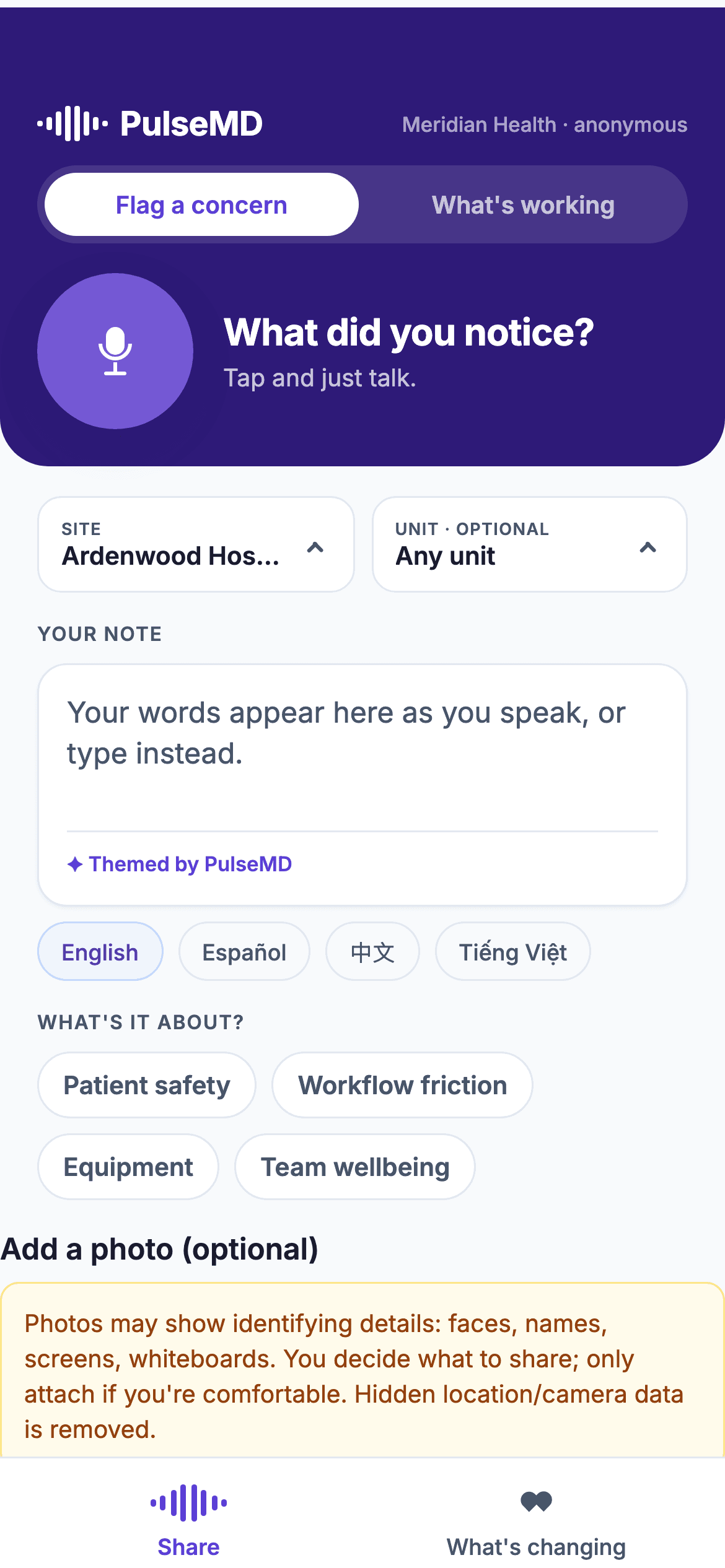
Early-signal intelligence for physicians: a 10-second upstream complement to ERS.
ERS captures what happened. PulseMD captures what’s emerging. The physician signals that never reach the system, because they’re too small to log, unclear if reportable, or captured only in conversation. PulseMD gives them somewhere to go.
Start with what patients, clients and families experience.
The people receiving care see communication, continuity, dignity and trust from the outside in.
PulseMD preserves those observations while context is intact, then brings staff’s inside operational signal alongside them. For your role, the value is not more comments; it is a clearer pattern, with enough context to decide what deserves attention.
Signals that never reach ERS
- “Too small” to log as an event, but it keeps happening
- Workflow friction that slows you down every shift
- Near-misses and handoff issues captured in conversation, not systemically
- Staffing and load pressure, equipment and process breakdowns, team dynamics
What changes when the early signal reaches you.
Ten seconds, not a form
Voice or text, between moments of care. No classification, no judgement about whether it “qualifies.”
ERS is essential, but reactive
PulseMD sits upstream of incident reporting with minimal-to-no integration, alongside your existing workflows.
The economics leaders care about
Physician experience can translate into better utilisation, referrals, throughput and retention, the case a CMO makes to a CFO.
The honest answer
Is this one more thing for an already-stretched physician to do?
It’s the opposite of a burden, a 10 to 20 second observation when something’s worth noting, with no form to complete and no incident to justify. The point is to lower the cost of being heard, not raise it.
Solutions for this role
Patient-safety early signals
The most important safety signals are judged too small to log, too uncertain to report, so the early warning is lost and the near-miss goes untracked.
ExploreOperational drift & throughput
Handover friction, bottlenecks and coordination gaps rarely trigger a formal report, they just quietly tax throughput and sustainability, every shift.
ExploreWorkforce strain & retention
Pressure accumulates silently. By the time it shows up in a vacancy rate or an engagement survey, the cost is already paid.
ExploreHear what people notice now, not what they can still remember later.
Start with patient and family voice in one setting, or combine it with staff signal from the beginning. Minimal-to-no integration, no workflow redesign and an honest pilot plan.
A senior member of our team responds the same business day. · Explore the Trust Center